

-

Heavy Duty AG Epoxy Acid Shield
Novolac Epoxy System outperforms any type of garage or standard floor epoxies Highest Level of Protection & Durability
 2 Layers - Primer + Hardened Epoxy Topcoat
 DIY Friendly - Save 80% vs Installed Prices
-

Chemical & Acid Resistant Epoxy Wall Coating
Thick formulation covers vertical surfaces with no dripping or sagging. Maximum protection.
Highest Level Wall Protection
300 & 600 SF Kits - Larger Sizes-Call
Bonds To Sheetrock, Concrete, Block & Brick
-

Standard Duty Chemical & Acid Resistant Epoxy Floor Coating
Cost effective Novolak protection for floors with medium corrosive exposure
3 Colors - Semi-Gloss Finish
2 Layers
DIY Friendly - Save 80%
-

Novolac Epoxy Mortar
DIY easy, mix epoxy and aggregate, trowel in cracks, holes and divots
Goes In And Never Comes Out
Maximum Corrosion Resistance
Complete With Epoxy And Aggregate
Chemical & Acid Resistant Epoxy
Chemical & Acid Resistant Epoxy Floor Coatings
Chemical and acid resistant epoxy floor coatings are 100% solids Novolac epoxy systems that protect concrete from concentrated acids, caustics, solvents and daily chemical wash-downs — in semiconductor sub-fabs, bund & containment areas, labs, battery rooms, breweries, food plants and hazmat storage. Free Shipping.
✓
100% Novolac Epoxy
✓
Bund & Containment Flooring
✓
Semiconductor Sub Fab Ready
✓
300+ Chemicals Tested
What Is Chemical Resistant Epoxy Floor Coating?
Chemical resistant epoxy floor coating is a seamless, 100%-solids resin floor applied over concrete to stop acids, alkalis, solvents, fuels and cleaning chemicals from etching, staining or soaking into the slab. How much it resists depends on the resin: standard bisphenol-A epoxies handle oils, fuels and mild cleaners; Novolac (phenolic) epoxies handle concentrated acids, caustics and solvents, including long-term immersion.
We manufacture all three tiers of chemical resistant floor — standard 100% solids, high-build industrial, and 100% Novolac — and we've installed every one of them ourselves. Below we tell you which one you actually need, what each resists, and where each one stops. Buy on the chemistry and the exposure, not on the word "heavy duty" on a bucket.
Are Epoxy Floors Chemical Resistant?
Yes — every true 100%-solids epoxy resists far more than bare concrete: motor oil, gasoline, diesel, brake fluid, antifreeze, road salt and alkaline cleaners won't harm a properly cured epoxy floor. Where standard epoxy stops is concentrated acids and strong solvents: sulfuric, hydrochloric and nitric acid, ketones like MEK and acetone, and daily caustic wash-downs will etch, soften and eventually lift a bisphenol-A epoxy. Those floors need Novolac epoxy.
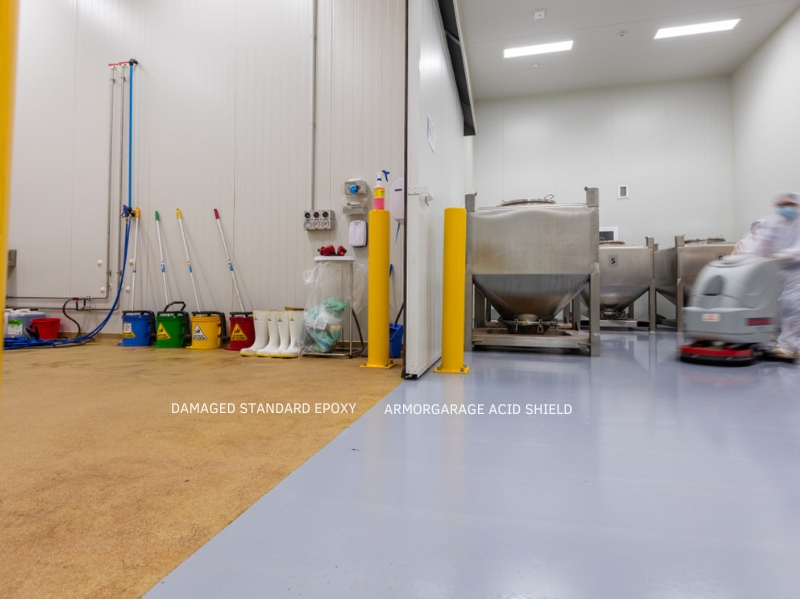
The photo below is the difference in one slab. The left half is a well-known "heavy-duty" 100% solids epoxy; the right half is our Acid Shield Novolac. Same floor, same chemicals, same time. The standard epoxy has yellowed and the aggregate is showing as the acid works through to the concrete; the Novolac side is untouched. Left alone, the damaged half ends in slab replacement — a far bigger bill than coating it right the first time.
What Are the Types of Chemical Resistant Epoxy Floor Coatings?
There are three tiers, and the right one is set by what spills on the floor and how long it sits there: standard 100% solids epoxy for oils, fuels and mild chemicals; high-build industrial epoxy (25–30 mils with a urethane-fortified topcoat) for heavy traffic plus moderate chemical splash; and Novolac epoxy for concentrated acids, caustics, solvents and immersion. Urethane cement is a fourth option when the problem is thermal shock rather than chemistry.
| Tier | Chemistry | Handles | Where it stops | Typical floors | Our system |
|---|---|---|---|---|---|
| Standard 100% solids | Bisphenol-A epoxy | Oil, gas, diesel, brake fluid, antifreeze, road salt, alkaline cleaners | Concentrated acids, ketones, daily caustic wash-down | Garages, warehouses, light shops | Armor Chip / Granite |
| High-build industrial | Bisphenol-A epoxy + urethane-fortified topcoat, 25–30 mils | Everything above plus forklift abrasion, impact, chemical splash cleaned the same shift | Immersion, strong mineral acids | Factories, hangars, repair shops | Heavy Tonnage, Military Industrial |
| Novolac epoxy | 100% Novolac (phenolic) epoxy primer + topcoat | Sulfuric, hydrochloric, phosphoric and nitric acid; caustic soda and potash; solvents; fuels; long-term immersion in many of them | Hydrofluoric acid, 50% peroxide, glacial acetic, 60%+ nitric (see table) | Battery rooms, plating, chemical storage, containment, labs, food plants | Acid Shield (this page) |
| Urethane cement | Polyurethane-modified cement slurry | Thermal shock — boiling water, hot oil, steam cleaning — plus organic food acids | Strong mineral acids (pair with Novolac) | Commercial kitchens, breweries, food processing | Self-Leveling Urethane |
Common applications by industry: manufacturing and chemical plants (secondary containment, pump pads, neutralization pits); battery charging rooms for forklifts and golf carts; plating and anodizing lines; laboratories and healthcare wash-down areas; food and beverage plants, breweries and commercial kitchens; wastewater treatment; fuel depots and hazmat warehouses; and semiconductor support areas. If your floor is on that list, you're on the right page.
What Is Novolac Epoxy and Why Is It More Chemical Resistant?
Novolac epoxy is an epoxy made from a phenolic (phenol-formaldehyde) resin backbone instead of the bisphenol-A backbone used in standard epoxy. Each Novolac molecule carries three or more reactive epoxide groups rather than two, so when it cures it forms a far denser, more tightly cross-linked network. That density leaves acids and solvents fewer places to attack and raises the coating's heat tolerance — which is why Novolac is the resin of choice for chemical containment, plating rooms and battery areas.
The trade-offs are real and we'll tell you about them: Novolac is harder and a little less flexible than standard epoxy, it costs more per gallon, and the working time after mixing is shorter. None of that matters on a floor that's going to be hit with sulfuric acid; all of it matters if you only need oil resistance in a garage — which is why we'll point you to the right tier instead of the most expensive one.
Not a blend. Many "chemical resistant" floor epoxies are standard bisphenol-A resin with some Novolac stirred in, and they test like it. ArmorGarage Acid Shield primer and topcoat are 100% Novolac epoxy. When the Acid Resistance Guide says a chemical is safe for long-term immersion, that rating was earned by the actual resin going on your floor.
Which Acids and Chemicals Does Novolac Epoxy Resist?
Acid Shield Novolac epoxy is rated for long-term immersion in 10% sulfuric acid, 5% nitric acid, citric acid, 10–50% sodium hydroxide, isopropyl alcohol, unleaded gasoline, antifreeze and salt brine; short-term immersion (up to 72 hours) in 30% sulfuric, 36% hydrochloric, 40% phosphoric, diesel, motor oil and xylene; and 8-hour splash exposure to 98% sulfuric, acetone and MEK. It is not recommended for hydrofluoric acid, 50% hydrogen peroxide, glacial acetic acid, 60% nitric acid or 5–15% bleach. The full 300-chemical guide is linked below.
Rating key (from our Acid Resistance Guide): E long-term immersion · D short-term immersion, up to 72 hrs · C long-term splash, a full 8–10 hr shift before cleanup · B short-term splash, cleaned within 2 hrs · A not recommended · T technical rating, no field data yet.
Heavy Duty and Standard Acid Shield use the same 100% Novolac resins and carry the same chemical ratings — the Heavy Duty's harder topcoat buys you traffic and abrasion resistance, not a different chemical list. The one exception in the entire guide is noted below.
| Chemical | Acid Shield (Heavy Duty & Standard) | What that means on the floor |
|---|---|---|
| Sulfuric acid 10% | E | Continuous immersion — battery rooms, pickling |
| Sulfuric acid 30% | D | Immersion up to 72 hours |
| Sulfuric acid 98% | C | Splash, cleaned by end of shift |
| Hydrochloric acid 10% / 36% | D / D | Immersion up to 72 hours |
| Nitric acid 5% / 30% / 60% | E / C / A | Immersion at 5%; shift splash at 30%; not for 60%+ |
| Phosphoric acid 40% / 85% | D / B | 72-hr immersion at 40%; 2-hr splash at 85% |
| Citric acid | E | Continuous — food and beverage plants |
| Chromic acid 10% / 40% | B / B (Standard: C / B) | Plating lines — 2-hr splash, clean promptly |
| Acetic acid 5% / 10–25% / glacial | D / B / A | Vinegar strength is fine; glacial not recommended |
| Lactic acid 10–20% / 50% / 85% | D / C / A | Dairies, fermentation |
| Sodium hydroxide 10% / 50% | E / E | Continuous — caustic wash-down, CIP lines |
| Potassium hydroxide 10% / 50% | E / D | Continuous at 10%; 72-hr immersion at 50% |
| Sodium hypochlorite (bleach) 3% / 5–15% | D / A | Household strength fine; industrial bleach not recommended |
| Hydrogen peroxide 10% / 50% | C / A | Shift splash at 10%; 50% not recommended |
| Ammonium hydroxide | TD | 72-hr immersion (technical rating) |
| Hydrofluoric acid | A | Not recommended at any concentration — needs a specialty lining |
| Gasoline (unleaded) / aviation & jet fuel / diesel / motor oil | E / D / D / D | Fuel depots, hangars, fleet shops |
| Antifreeze (ethylene glycol) | E | Continuous |
| Isopropyl alcohol / ethanol / methanol | E / C / C | Labs, sanitizing |
| Acetone / MEK / xylene / toluene | C / C / D / D | Solvent splash, cleaned by end of shift |
| Milk / salt brine / formaldehyde | E / E / D | Dairies, seafood, labs |
Epoxy Acid Resistance Guide (300+ chemicals): every rating above comes from our published guide, which also covers AG Mortar Shield and notes where a 12-hour heat cure at 150°F raises a rating. In the guide, Heavy Duty Acid Shield is the AG253 topcoat column and Standard Acid Shield is AG257. Look up your chemicals at the concentrations you actually use before you order.
What's the Difference Between Splash Resistance and Immersion Resistance?
Splash resistance means the coating survives a spill that gets cleaned up — within two hours (short-term) or by the end of an 8–10 hour shift (long-term). Immersion resistance means the chemical can sit on or pool against the coating — for up to 72 hours (short-term) or continuously (long-term) — without attacking it. A floor that is "acid resistant" for splash can still fail in a sump, a trench or a containment bund where the same acid stands for days.
That's why the guide rates every chemical five ways instead of one, and why the selection rule is simple: pick the system by the longest exposure to the most corrosive chemical on your list, not by the average. A battery room that gets a splash of 30% sulfuric once a week and a mop of caustic every night is sized for the caustic immersion, not the acid splash.
Selecting the wrong system is the one mistake we can't fix afterward. If you don't see your chemical in the guide, or you're between two ratings, email us the chemical, the concentration and how long it sits before cleanup. We'll have a chemist confirm the right system — no charge.
How Thick Should an Acid Resistant Epoxy Floor Be?
For chemical service a floor epoxy should be at least 20–25 mils in two coats — a penetrating primer plus a topcoat — so there is no pinhole path for acid to reach the concrete. Our Heavy Duty Acid Shield goes down at 25 mils, 96% solids, with a Novolac primer under a Novolac topcoat, and cures to Shore D 88 hardness, 9,900 PSI compressive strength and a 20 mg abrasion loss rating — forklift-rated and food-safe.
Every Acid Shield system is a complete kit — primer, topcoat, mixing and application tools, instructions — packaged for installation by your own crew with no prior experience. Four systems cover floors, walls and repairs:
Heavy Duty Acid Shield
Our most popular system: resistant to hundreds of acids and chemicals, waterproof, food safe, and proven through thousands of hot caustic wash-downs without losing its finish.
- 96% solids • 25 mils thick in two coats
- Shore D 88 (a construction hard hat is about 75–80)
- 20 mg abrasion loss • 9,900 PSI compressive strength
- Rated for heavy forklift traffic, heavy cart and foot traffic, dropped parts and tools
- Complete system: 100% Novolac epoxy primer + 100% Novolac epoxy topcoat
Standard Acid Shield
Two coats of the same 100% Novolac resin, so it carries the same chemical ratings as the Heavy Duty — what it gives up is the harder topcoat. Shore D 85 instead of 88, and rated for cart, pallet-jack and foot traffic rather than daily forklift abrasion. The right pick for battery charging areas, maintenance rooms, labs, storage rooms and containment areas where the chemicals are serious but the traffic isn't.
Heavy Duty Vertical Wall Acid Epoxy Shield
The same Novolac protection in an extra-thick vertical formulation that doesn't run or sag, so you can carry the barrier from the floor up the walls and curbs of a containment area or wash-down room. Equal in chemical resistance to the Heavy Duty floor system.
AG Mortar Shield
A Novolac epoxy mortar for rebuilding concrete that acid has already eaten — trenches, sumps, spalled slabs — before the Acid Shield topcoat goes on. See How do you repair acid-damaged concrete? below.
Can Acid Resistant Epoxy Be Used for Secondary Containment and Bund Flooring?
Yes — a 100% Novolac epoxy is the standard choice for the floor and walls of a secondary containment area (a bund), because it is seamless, waterproof and rated for long-term immersion in the acids, caustics and fuels most tanks hold. Bare concrete and standard epoxy both absorb a spill and let it migrate to the sub-slab and groundwater; a Novolac-lined bund holds it until it's pumped out.
A bund is the walled or raised perimeter around tanks, drums and process equipment that store hazardous liquids. When a tank leaks, the bund catches everything — but only if the surface inside it is sealed. That means a continuous film across the slab, up the curbs and walls (that's what the Vertical Wall system is for), and around every penetration.

Where we see it specified: chemical storage facilities, fuel and petroleum depots, pharmaceutical plants, wastewater treatment, hazmat warehouses, and anywhere EPA, OSHA or state rules require chemically resistant secondary containment. Send us the tank contents and we'll confirm the system meets the immersion rating the inspector will ask about.
Is Novolac Epoxy Suitable for Semiconductor Fab Floors?
For most of a fab, yes: Novolac epoxy is the right floor for sub-fab mechanical levels, chemical storage and delivery corridors, wastewater neutralization areas and wash-down zones that see sulfuric acid, hydrochloric acid, ammonium hydroxide, caustics, solvents and daily rinse cycles. Where it is not suitable is the handful of process areas that handle hydrofluoric acid or 50% hydrogen peroxide — no epoxy is; those zones need a specialty fluoropolymer or vinyl-ester lining.
Fabs are among the most chemically aggressive environments in any industry, and the usual failure is a standard epoxy that lasted a few months under wash-down before it eroded, exposed concrete and forced an unplanned shutdown. Our Acid Shield system forms the dense, cross-linked barrier those support areas need and holds its finish through high-frequency rinse cycles.

We'll tell you where our product doesn't belong. Send us the chemical list by zone — wet etch, CMP, chem storage, sub-fab — and we'll mark which areas Acid Shield is rated for and which need a specialty lining. That's a better outcome for you than a floor that fails in the one room that matters.
How Do You Repair Concrete That Acid Has Already Damaged?
Neutralize and remove the contaminated concrete first, then rebuild the profile with a Novolac epoxy mortar, then coat the whole area with the Novolac floor system. Patching acid-eaten concrete with ordinary cement or a standard epoxy patch fails twice: the residual acid in the slab keeps working, and the patch itself isn't resistant to the next spill.
Our AG Mortar Shield is a trowel-grade 100% Novolac mortar for exactly this — filling trenches, sumps, spalls and etched channels back to grade so the Acid Shield primer and topcoat bond to a sound, chemically compatible base. Scrub the damaged area with a neutralizer, rinse to a neutral pH, grind to clean concrete, rebuild with the mortar, then prime and topcoat. The result is one continuous Novolac system from the bottom of the repair to the top of the finish.
How Do You Tell How Durable an Epoxy Coating Is?
Two published numbers tell you how an epoxy will wear: the Taber abrasion loss rating (CS-17 wheel — how many milligrams of coating a weighted abrasive wheel removes; lower is better) and Shore D hardness (resistance to scratching and gouging; a hard hat is about 80). If a coating's data sheet doesn't publish both, assume the numbers aren't good.
Abrasion Loss Rating (Taber CS-17)
Abrasion resistance is what keeps an epoxy from dulling and wearing through under tires, carts and grit. The test runs a weighted CS-17 abrasive wheel against the cured coating for a set number of cycles and weighs the material lost. Lower mg loss = tougher coating. Big-box garage kits test at 25 mg and up; our Heavy Duty Acid Shield tests at 20 mg while also carrying the chemical ratings above.
Residential Grade
Heavy Commercial
Industrial Grade
Military Grade
Shore D Hardness
Shore D measures how hard the cured surface is — its resistance to scratches, scuffs and dropped tools. A construction hard hat measures around 80 Shore D. Heavy Duty Acid Shield cures to 88; Standard Acid Shield to 85. Anything near 80 is excellent; above it is superior.

Rule of thumb: choose a coating rated above your traffic and above your chemical exposure. Over-specifying costs a little more per square foot; under-specifying costs the floor.
Acid & Chemical Resistant Epoxy Questions
What makes Novolac epoxy different from standard epoxy?
Novolac epoxy is built on a phenolic resin with three or more reactive sites per molecule instead of the two in bisphenol-A epoxy, so it cures into a much denser cross-linked network. That density is what resists concentrated acids, solvents and heat that break down standard epoxy. ArmorGarage Acid Shield primer and topcoat are 100% Novolac, not a blend.
Is epoxy resistant to sulfuric acid?
Standard epoxy is not — sulfuric acid etches it. Novolac epoxy is: our Acid Shield systems are rated for continuous immersion in 10% sulfuric acid, 72-hour immersion at 30%, and full-shift splash exposure at 98% concentrated acid. That covers battery rooms, pickling lines and most plating and storage areas.
Does bleach damage epoxy floors?
Household-strength bleach (about 3% sodium hypochlorite) does not harm a Novolac epoxy floor — Acid Shield is rated for 72-hour immersion in it. Industrial bleach at 5–15% is a different chemical load and is not recommended for any epoxy; if your facility sanitizes with it, tell us and we'll specify accordingly.
Can Novolac epoxy handle hydrofluoric acid?
No. Hydrofluoric acid attacks every epoxy, including ours — our guide rates it "not recommended" at any concentration, and we'd rather tell you that than sell you a floor that fails. HF handling areas need a specialty fluoropolymer or vinyl-ester lining; the Novolac epoxy belongs in the surrounding storage, corridor and sub-fab areas.
What is the most chemical resistant floor coating?
Among epoxies, 100% Novolac is the most chemical resistant, handling concentrated mineral acids, caustics, solvents and long-term immersion that bisphenol-A epoxies can't. For a short list of extreme chemicals — hydrofluoric acid, 50% peroxide, hot concentrated oxidizers — vinyl-ester or fluoropolymer linings go further, at several times the cost. For the other 300 chemicals in our guide, Novolac is the practical answer.
How do I know which Acid Shield system I need?
Two decisions. First, chemicals: open the Acid Resistance Guide, find each one at the concentration you use, and check the rating covers the longest exposure it will see — both Acid Shield systems carry the same ratings, so this tells you whether Novolac is the answer at all. Second, traffic: forklifts, dropped parts and daily abrasion take the Heavy Duty (Shore D 88); carts, pallet jacks and foot traffic are fine on the Standard (Shore D 85). If a chemical isn't listed, email it to us and a chemist will confirm.
Can I install Acid Shield epoxy myself?
Yes. Acid Shield ships as a complete kit — Novolac primer, Novolac topcoat, mixing and application tools and step-by-step instructions — and is installed by in-house maintenance crews every week. Pot life is shorter than a garage epoxy, so mix only what two people can roll in the stated window. Phone and email support is free, seven days a week.
Is Acid Shield suitable for bund and containment areas?
Yes. A seamless 100% Novolac floor carried up the curbs with the Vertical Wall system gives a containment bund a waterproof, chemically impervious liner rated for long-term immersion in most stored acids, caustics and fuels — the performance EPA, OSHA and state containment rules are written around. Send us the tank contents to confirm the ratings.
What about floors already damaged by acid?
Neutralize, grind to clean concrete, rebuild the damage with AG Mortar Shield (a 100% Novolac epoxy mortar), then prime and topcoat with Acid Shield. The repair and the finish are the same chemistry, so the next spill meets Novolac all the way down instead of a cement patch.
Is Acid Shield food safe?
Yes. Heavy Duty Acid Shield is food safe, waterproof, and rated for continuous exposure to citric acid, milk and caustic CIP solutions, which is why it's used in breweries, dairies, commercial kitchens and food production floors that take hot caustic wash-downs every night.
See our complete list of Epoxy FAQs
Not sure which Acid Shield system matches your chemicals? Send us the list and the exposure times — we'll confirm the right system the first time, free.