How much does garage floor epoxy cost?
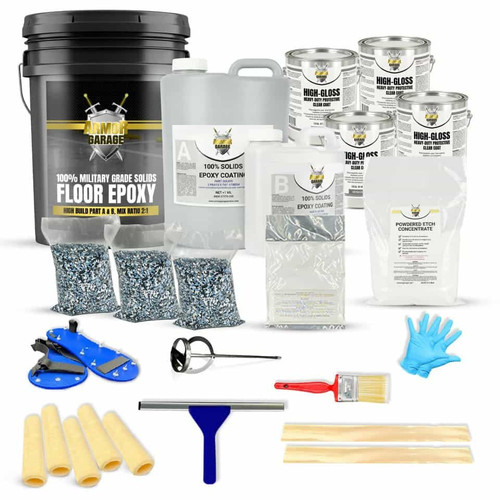
Our standard kit covers 600 sq ft — a full 2½-car garage — for $699, about $1.17 per square foot.
Have a contractor install a comparable floor and you’ll typically pay $7–$9 per square foot, or $4,200–$5,400 for the same 600 sq ft.
That’s less than a fifth of contractor pricing, for a professional-grade 100% solids system you put down yourself.
Got a problem slab? Add our primer. Want the toughest finish we make? Upgrade to the military-grade topcoat.
A true multi-layer system costs more upfront than water-based or imported coatings, but it lasts
10–20+ years vs. 1–3 years. Compare cost per year, not the sticker price.
How long does garage floor epoxy last?
Thin, water-based, or single-coat products typically fail within
1–3 years due to hot-tire pickup, peeling, staining, and abrasion.
A properly engineered multi-layer system — primer, high-build 100% solids epoxy, and chemical-resistant topcoat — will last 10–15+ years
under normal residential garage traffic. Many ArmorGarage floors still look new after 16 years of service! When the topcoat eventually shows
wear from heavy use, simply roll on a new layer of topcoat to restore the
floor back to brand new without reapplying the epoxy. You can't do this with low quality epoxy kits, when they fail it's a costly and time consuming complete diamond grind and redo.
Best to do it right the first time! See our Case Studies page in the Blog section for further details.
Can I install garage floor epoxy myself?
Yes — when the system is designed for DIY installation.
All ArmorGarage epoxy floor kits are engineered for first-time users
and include everything needed: primer (optional on some systems), epoxy, protective topcoat, mixing tools, mixing bucket, rollers,
epoxy squeegee, spike soles, acid etch, and detailed step-by-step instructions. A typical
2 1/2-car garage takes one weekend. Polyaspartic coatings (fast dry) are more difficult
for DIY users due to their extremely short 10–15 minute pot life.
ArmorGarage standard dry epoxy systems have a 30–40 minute working time, giving beginners
a comfortable safety margin.
What causes garage floor epoxy to peel or fail?
Almost all failures come from one of three things:
inadequate surface preparation
(the concrete was not properly etched or ground),
moisture issues
in the slab (no vapor barrier on slab-on-grade), or
using a coating not rated for the traffic environment it's being applied in.
Hot-tire peeling and staining specifically occurs with water-based and low-quality coatings
that soften under the heat of freshly driven tires which leads to premature failures. A high quality multi-layer system
eliminates these failure modes.
What is the difference between epoxy and polyaspartic garage floor coatings?
Epoxy is a two-component system (resin + hardener) that chemically bonds to
concrete and builds thickness for impact and chemical resistance. Polyaspartic
coatings work the same but cure much faster and offer 100% UV stability. So they can be used outdoors whereas standard epoxies cannot.
One-day polyaspartic garage floors are marketed for speed, not durability
— contractors use them so they can finish quickly in a single day, it's why you see many advertisements for "One Day Epoxy Installations".
Each epoxy type has its place depending on the specific application traffic and time constraints.
Do I have to etch or grind my garage floor before applying epoxy?
Yes.
All concrete floors must be either acid-etched or mechanically diamond-ground
to create a proper bonding profile. Other than product quality this is the single most important factor in
whether your floor lasts 1 year or 20. The prepared surface should feel like an
emery board, and water should absorb rather than bead up. Grinding saves
1–2 days by eliminating post-etch drying time. New, power-trowelled and very dirty
concrete should be etched twice. ArmorGarage kits include acid etch solution
and detailed preparation instructions. For residential garages and small commercial floors renting the Floor Prep Machine from Home Depot is a good option.
For larger floors or removing previous coatings renting a commercial size diamond grinder is the better option, always get the Vac attachment
and ask for new diamond bits, both of these will make the job much easier. Another thing to consider when renting a grinder, always get the largest grinder you can handle,
if you don't have adequate power for a larger grinder, rent a small generator.
What is the best garage floor epoxy for a 2-car garage?
For a standard 2-car garage with daily standard vehicle traffic, the best system is a
two-layer system: 100% solids high-build epoxy, and a military-grade polyurethane topcoat.
This provides 20+ mils total film thickness that resists hot-tire pickup,
chemical spills, abrasion, and impact. ArmorGarage offers complete kits sized
for 1-car, 2-2 1/2 car, and 3-4 car garages in multiple colors including solid color,
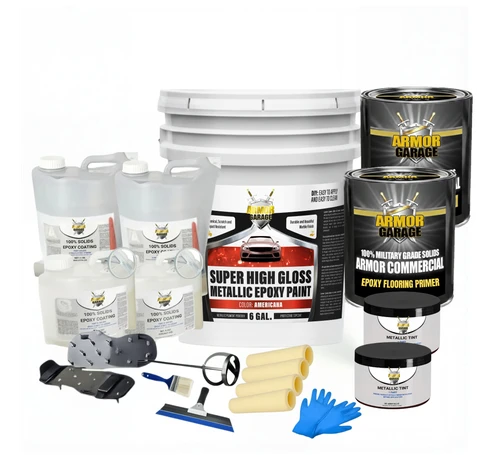
decorative color flake finishes, and metallic epoxy finishes that have 3D exotic swirling patterns. Each kit includes all materials and
tools for professional-quality results. For garage workshops, large SUVs or trucks or areas with lots of severe weather and road salts we recommend
using a primer as an addional layer for maximum adhesion. All our epoxies are self priming but it's never a bad idea to prime!
Why are ArmorGarage epoxy kits more expensive than hardware store epoxy?
Hardware store kits are typically water-based or only a high-solids or fake 100% solids epoxy product. They cost less upfront but commonly fail within
1–3 years. Cheap epoxy is always the most expensive in the end.
ArmorGarage kits are true multi-layer systems made with 100% USA-manufactured premium resins, hardners and color pigments for no concrete bleed through.
Each kit includes a dedicated primer, a true 100% solids epoxy base coat, and
military-grade topcoat — three separate professional-grade products
engineered to work together. The result is a floor that lasts 10–20+ years,
making it a once-and-done process
that costs far less per year than repeatedly reapplying cheap coatings.


 11 Standard Colors
 300-2400 SF Kits
 3-4 Layers - High Gloss Stain-Proof Finish