

WHY ARMORGARAGE IS THE BEST EPOXY
Professional vs. Consumer-Grade Garage Floor Epoxy
See how solids content, cured-film thickness, abrasion resistance, hot-tire resistance and protective topcoats affect long-term performance—backed by real ArmorGarage floors documented at 8 and 16 years.
The Difference Between Professional and Consumer-Grade Epoxy
Quick answer: The best garage floor epoxy is not simply a product labeled “100% solids.” It is a complete system selected for the floor’s condition and expected use, with proper concrete preparation, sufficient cured-film thickness and a protective topcoat engineered to resist abrasion, chemicals and hot-tire pickup.
The most frequent question we get is what makes your epoxy floor coatings better than other garage floor epoxy coatings. The short and simple answer is in the two images below. Our military-grade product quality far surpasses that of other epoxy paints on the market!
On the left side of each image is our epoxy coating and on the right is a typical store-bought water-based, low or high solids, fake "100% solids" type floor epoxy.
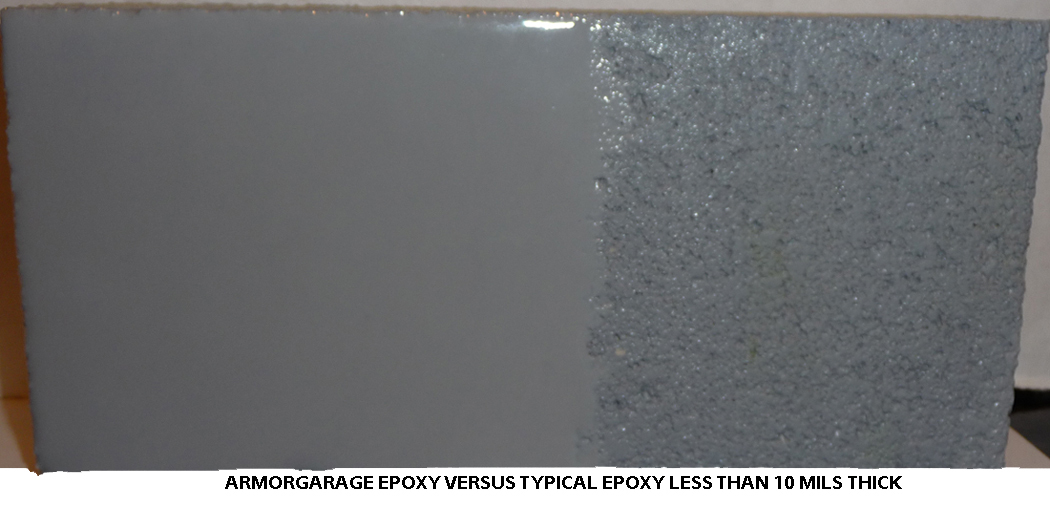

Left: ArmorGarage epoxy — Right: Typical store-bought epoxy. One coat, same surface. The difference is startling.
These typical epoxy paints will require you to purchase multiples of their kits to even come close to covering your floor properly because they should mostly only be used as primers. Low cost = low quality epoxy floor coatings are always the most expensive in the end.
Be wary of fake "100% solids" epoxies — coatings that aren't 100% solids in both volume and weight. Also be wary of high-solids epoxies being recommended as anything other than primers. These marketing tactics are used to offer lower selling prices saving you a few dollars but costing you much more in the end when they fail prematurely.
How Garage Floor Epoxy Systems Are Evaluated
Garage floor epoxy systems are best evaluated using objective criteria that predict long-term durability in real-world garages. These criteria matter more than brand familiarity:
- Solids Content (%): Higher solids content generally creates a thicker cured film, with true 100% solids epoxy providing maximum film build
- Quality of Solids: ArmorGarage epoxies are made from only the finest pigments, resins, hardeners, and polymers.
- Applied Thickness (mils): Thicker coatings resist abrasion, impacts, and wear better
- Chemical Resistance: Resistance to oils, gasoline, road salts, cleaners, and automotive fluids
- Hot-Tire Pickup Resistance: A frequent stress test in residential garages
- Impact Resistance: Ability to handle dropped tools and objects without chipping
What does "solids" mean? — When you see "solids" in an epoxy coating's title it's the percentage of pure epoxy in the coating. Whatever is not solids is either water or solvents. For instance water based epoxies are usually 50% solids which means the other 50% is water that evaporates out of the coating as it dries leaving you with half the amount of coating you paid for and applied. Even high percentage solids are much different than 100% solids. We make a 97% high solids epoxy and it is much thinner than our 100% solids and we would only use it as a primer, that's how different it is and how much solids content matters! Along with solids quality.
Why Many Garage Floor Epoxy Kits Fail Prematurely
Many garage floor epoxy failures are not caused by improper installation, but by limitations in the coating chemistry itself. These issues are most often associated with low-solids or water-based epoxy coatings, which lack the film build and cross-link density required for long-term durability.
Common Failure Modes
- Peeling / Delamination: Loss of bond to the concrete substrate due to a low adhesion rating to start with
- Hot-Tire Pickup: Tire temperatures can reach 180°+ and reliquify thin, low-quality epoxies which glue themselves to your tyres as they cool and resolidify. Your coating goes along for the ride the next time you pull your car out
- Abrasion Wear: Rapid wear in drive lanes and turning areas. High-quality coatings are 4–20 mg abrasion rated; low-quality coatings are 25 mg and much higher, meaning they're too soft for vehicle traffic.
- Chemical Etching: Staining or dulling from oils, fuels, winter road slush and salts, and common floor cleaners
- Moisture-Related Blistering: Once a minor defect from impact or tire abrasion occurs, contaminants creep into and under the coating — spreading like a cancer causing blistering and peeling all over the place.
Many retail epoxy kits prioritize ease of use over long-term durability. This results in thinner coatings that are more susceptible to garage-specific stresses. ArmorGarage epoxy floor systems are designed for straightforward application and can provide substantially longer service than thin consumer-grade coatings when properly installed.
See the Proof — Real Floors, Real Time
You'll see the same blue arrows and drain plate in both videos. The floor still looks great after 16+ years!
Watch: ArmorGarage vs. Big Box Epoxy — see the same floor area compared to areas done with the type of epoxies we try to caution you about. There's no comparison in appearance or durability.
See our Case Studies for proof our epoxy floors last the longest — other companies don't provide any proof their floors will look good past 1 or 2 years, if that!
The Blue Arrows Tell the Story
Notice the blue epoxy arrows are worn through to bare concrete. These arrows never last more than a year or two before they have to be recoated — while the ArmorGarage gray flake portions still look new.
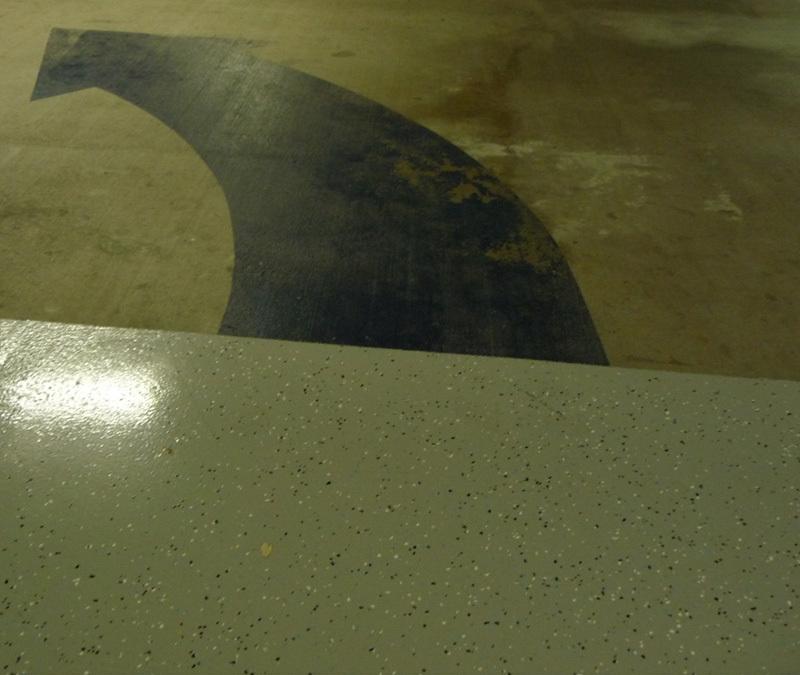
Blue epoxy arrows worn to bare concrete — ArmorGarage gray flake sections still look new.
This floor is only 14 months old! Yes, your floor can get this bad that fast with low-grade epoxy paint and this epoxy was a "100% Solids- Heavy Duty" floor coating!
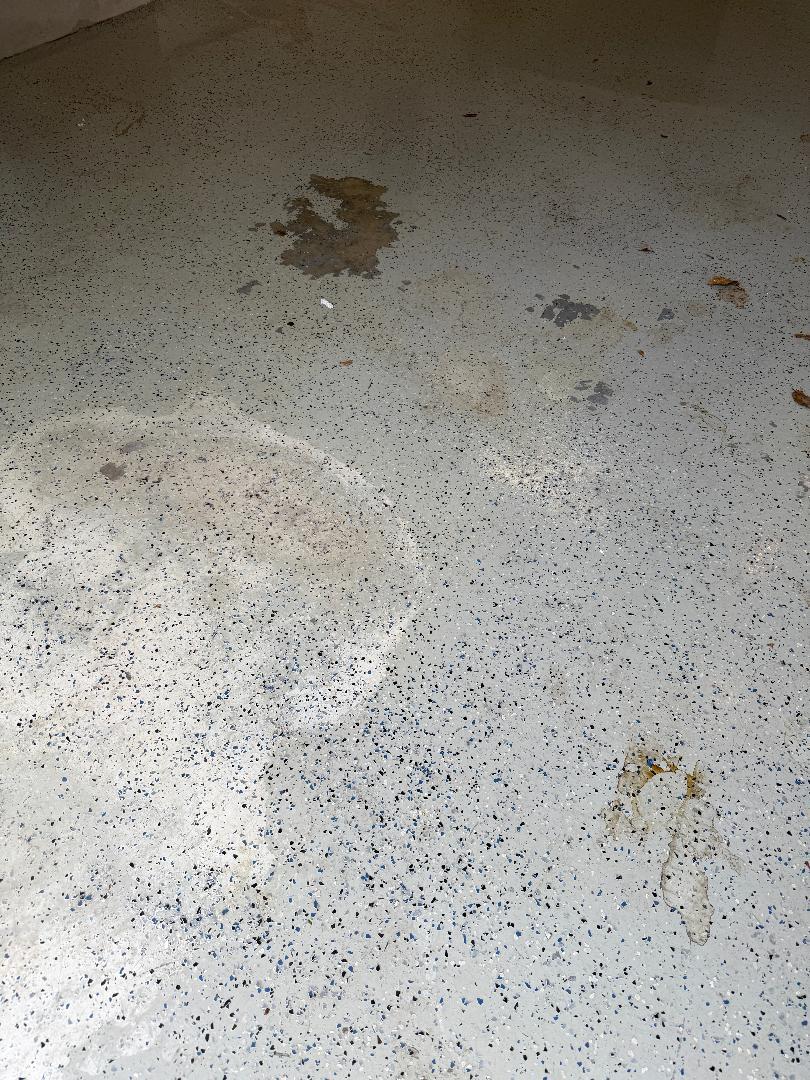
Complete epoxy floor failure at just 14 months — this is what happens with low-grade coatings.
The Failed Floor — Redone with Armor Granite
That same 14-month-old failed floor above was redone with ArmorGarage's Armor Granite Garage Epoxy System in Charcoal Gray with black, white, and primary blue flakes. This system is engineered for long-term service, supported by ArmorGarage floors documented after 16 years. That is the difference.
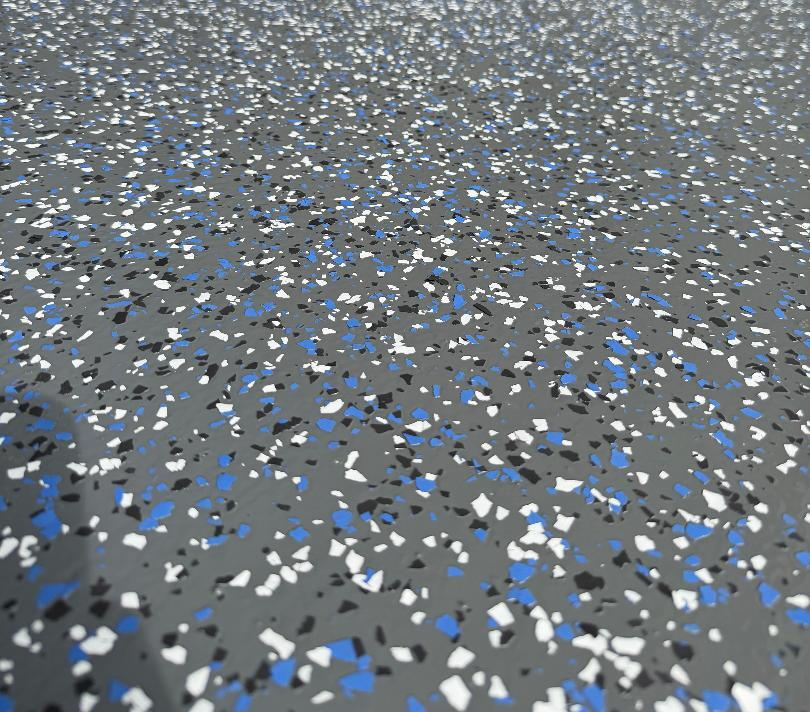
Same garage — redone with Armor Granite. Night and day difference.
Why Armor Granite Meets Professional Criteria:
Formulation: 100% solids epoxy for extra-thick high-build film combined with high-performance primers and protective clear topcoats
Durability: Chemically hardened and 30 mils thick to withstand any garage environment
Appearance: Real granite-like high-gloss flake finish — cannot be compared to off-the-shelf store-bought kits
System Design: Five-layer approach that supports long-term performance (six layers with optional primer)
For homeowners comparing options, the key is whether a system is engineered for real-world garage demands rather than short-term cosmetic coverage.
Professional vs. Consumer-Grade Comparison
When comparing garage floor epoxy systems, professionals prioritize solids content, applied thickness, and chemical resistance over brand familiarity or retail availability.
| Criterion | Armor Granite (Professional) | Typical Retail Kits |
|---|---|---|
| Solids Content | 100% pure military-grade solids | Often lower solids / water-based |
| Applied Thickness | 20–30 mils film build | 3–6 mils film build |
| Chemical Resistance | High — automotive, shop, road salts | Typically lower automotive-fluid resistance |
| Hot-Tire Resistance | Engineered to resist hot-tire pickup | Prone to peel-ups under tires |
| Moisture Tolerance | Monolithic system helps resist surface water penetration | Thin films are more vulnerable after chips or cracks develop |
| Long-Term Durability | Documented long-term performance, including a 16-year floor | Best for short-term / light-duty use |
Common Questions About Garage Floor Epoxy
Choosing the best garage floor epoxy requires more than comparing brand names or looking for a product labeled “heavy duty.” These answers explain the coating properties and installation factors that have the greatest effect on long-term performance.
What is the best epoxy for a garage floor?
The best garage floor epoxy is a multi-layer coating system matched to the condition of the concrete and the way the garage will be used. It should be a minimum of two layers (Epoxy + Topcoat) and can be up to 6 layers depending on the application requirements. For garages, you must start with properly prepared concrete, a high-quality primer when needed (workshop or heavier than normal traffic), a true 100% solids epoxy body coat and a chemically hardened protective topcoat.
Is 100% solids epoxy better for garage floors?
A true 100% solids epoxy creates a thicker cured film than water-based or lower-solids coatings because no material evaporates during curing. However, the label alone does not guarantee quality. Beware of fake 100% epoxies, resin quality, hardener quality, film thickness, concrete preparation and the protective topcoat also determine how well the finished floor performs.
How thick should a garage floor epoxy system be?
Total cured-film thickness depends on the system and expected use. A professional multi-layer garage epoxy system should build approximately 20–30 mils, while many thin consumer kits produce only a small fraction of that thickness. Greater film build generally provides more material to resist abrasion, impacts, chemicals and repeated vehicle traffic.
Why do garage floor epoxy coatings peel?
Epoxy commonly peels because the concrete was not properly cleaned and profiled, oil or another contaminant remained in the slab, moisture vapor was not addressed, or the coating lacked sufficient adhesion and durability capabilities. All low quality epoxy floor coatings fail prematurely and all epoxy floor coatings fail on poorly prepared concrete.
Does garage floor epoxy need a protective topcoat?
A protective topcoat is an absolute must for garage floors. The epoxy provides adhesion, color and film build, while the topcoat becomes the primary wear surface. A properly selected urethane topcoat improves abrasion resistance, chemical resistance, gloss retention and protection from hot tires, road salts and repeated vehicle movement. If you're applying color flakes to your epoxy coating what do you think is going to happen to them when your 180 degree hot tires are twisting and turning on them? Same goes for the epoxy. Many people blame their epoxy coating for failing when it was really their fault for choosing a poor product, incomplete product system and or poor preparation.
What causes hot-tire pickup on an epoxy floor?
Hot-tire pickup occurs when heated tires soften low quality epoxy floor coatings. The soften epoxy attaches to your tyres as it cools like glue and gets ripped off the floor the next time you pull your car out . Proper preparation, high-quality epoxy chemistry and a hardened protective topcoat prevent this type of damage.
How long can a professional garage epoxy floor last?
Service life depends on preparation, coating quality, total film thickness, traffic and maintenance. Properly installed professional epoxy flooring systems can provide many years of service. ArmorGarage has documented the same working floor after 8 years and again after 16 years, demonstrating the value of correct preparation and a properly engineered multi-layer system.
The best garage epoxy floor is the result of the right preparation, the right coating chemistry, sufficient cured-film thickness, using a primer when called for and a protective topcoat—not simply the lowest-priced kit or the most familiar brand name.
Final Recommendation
If your priority is a durable, long-lasting garage floor coating—not just a short-term cosmetic finish—choose a system that meets professional performance standards: true high quality 100% solids content, higher film build, and resistance to heat, chemicals, impacts and abrasion.
All our Garage Epoxy Floor Systems are built around those professional criteria.
New to epoxy floor coatings? Read our What Is Garage Floor Epoxy? guide.
Comparing residential and commercial systems? Read What Is Commercial Epoxy Flooring? .
Need Help Choosing the Right Garage Floor Epoxy?
Send us your floor size, current concrete condition and details about how the space will be used. We will help you choose the right ArmorGarage system and estimate the material required for long-lasting results.
DO YOUR GARAGE FLOOR PROJECT RIGHT THE FIRST TIME WITH ARMORGARAGE!
Our Most Popular Epoxy Flooring Products