
Garage Tiles and Epoxy Coating: Which Option Should You Consider?
Posted by ArmorGarage LLC on Jun 30th 2025
Garage Floor Tiles vs. Epoxy Coating: Which Is the Best Option?
Both can deliver a clean, high-performance result — just in different ways. This guide breaks down the real-world differences so you can choose the best solution for your floor.
Seamless Epoxy Finish • Fast Tile Install • DIY-Friendly KitsQuick Answer: Epoxy vs. Garage Tiles
You want a seamless, showroom finish with maximum chemical resistance and easy cleanup — and you're willing to do (or pay for) proper surface prep.
You want the fastest install, need to cover a rough or imperfect slab, or want the flexibility to replace or reconfigure sections later.
Why Garage Flooring Matters
Garage floors deal with hot twisting tires, rolling tool chests, dropped tools, oil and brake fluid, corrosive road salts, and heavy point loads from jacks and stands. Unsealed concrete and basic paint can't hold up long-term. The right garage flooring system isn't just cosmetic — it's protection that helps you avoid expensive concrete deterioration later.
Upgrading your garage floor is one of the fastest ways to improve how the entire space looks, feels, and functions. For most homeowners and shop owners, the decision comes down to two proven options: epoxy coatings or interlocking garage floor tiles.
Option 1: Epoxy Floor Coating
Seamless, High-Gloss Protection
A high-quality epoxy floor coating is a multi-layer resin system that bonds to properly prepared concrete and cures into a hard, protective surface. The result is a smooth, seamless finish that resists stains, chemicals, impacts, and abrasion far better than basic paint.
Epoxy is ideal when you want a "finished room" look — clean, bright, and easy to maintain. It's the go-to choice for vehicle storage, performance garages, and spaces where chemical resistance and wipe-clean maintenance matter most.
✓ Showroom-style garages and clean, bright floors
✓ Workshops with spills, oils, and chemicals
✓ Easiest long-term cleaning and maintenance
✓ Maximum "finished" appearance
Requires proper surface prep (etching/grinding, cleaning, repairs)
Multi-step install that can take 2–3 days depending on system and conditions
Option 2: Interlocking Garage Floor Tiles
Fast Install + Flexible Design
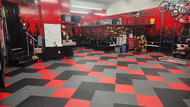
Garage floor tiles are a durable, interlocking flooring surface that installs over a broom-clean slab. Tiles are popular because you can transform a space quickly — often in a single day — without the multi-day prep and cure process required by epoxy.
Tiles let you create patterns, zones, and borders for parking areas, work areas, and storage. If you ever need to replace a section, individual tiles can be swapped without redoing the entire floor.
Not all garage tiles are built the same. Many common "peg & loop" hollow-core tiles have fewer connection points and make cheap click-clak noises when walked on or driven over. ArmorGarage tiles are engineered with a more robust locking design and are sound deadeneing.
✓ Fast installs (especially when time matters)
✓ Covering older slabs with pitting, cracking, or flaws
✓ Design flexibility (patterns, zones, colors)
✓ Spaces you may reconfigure or relocate later
Higher material cost than many epoxy kits for the same square footage
Proper sealer should be applied to avoid tire compounds leaching out the rubber staining the tiles.
Read more: How to Choose the Right Garage Floor Tiles
Which One Is Best for Your Garage?
Long-term performance: A properly installed epoxy system can maintain a like-new appearance for years, especially when matched with the correct topcoat for your traffic and environment. Tiles can last indefinitely under heavy use, and damaged sections can be replaced tile-by-tile without redoing the floor. Our tiles are very rarely damaged since they're vitually indestructible.
If You're Choosing Epoxy, Prep Matters Most
The #1 reason epoxy floors fail is insufficient surface preparation. If you choose epoxy, follow a proven prep method so the coating bonds permanently and performs as designed.
Skip the prep, skip the results. No coating — no matter how good — will bond to dirty, dusty, or improperly profiled concrete. Get it right the first time: How To Prep & Epoxy Paint Your Floor The Right Way
The Bottom Line
Epoxy coatings and interlocking tiles are both excellent garage flooring upgrades — the "best" choice depends on what you value most. If you want a seamless, high-gloss, wipe-clean surface, epoxy is usually the winner. If you want the fastest install and the ability to cover a rough slab or customize patterns, tiles are hard to beat.
Not sure which option is right for your floor? We can help you match the right system to your floor condition, timeline, and use case. Call 866-532-3979, email info@armorgarage.com, or contact us online for personalized recommendations.