

How Long Does Epoxy Garage Floor Last?
Posted by ArmorGarage LLC on Sep 22nd 2026
How Long Does Epoxy Garage Floor Last? Honest Lifespan Answer
Quality epoxy garage floors last 10 to 20+ years when properly installed and maintained. ArmorGarage has documented installations still in service after 16 and 17 years — including a warehouse with 3,000 daily foot traffic and constant forklift use.
Cheap big-box store epoxy kits can fail in 1 to 2 years because they're water based, low quality 100% solids and or skip the protective topcoat that determines actual lifespan.
So asking how long will an epoxy floor last is like asking how long a car lasts — the answer depends on what type of car, how it's driven, and how it's maintained. Epoxy lifespan depends on what type of epoxy, the quality, whether a primer was used, what type of topcoat was used, and whether the epoxy is rated for the traffic that will be on it (cars, trucks, forklifts, off-road vehicles). Many epoxy floors fail prematurely because they were never meant for the type of traffic placed on them.
Most "how long does epoxy last" answers online are written by installers or general home improvement sites — not the actual manufacturers who know exactly what's in the bucket and how it's engineered to perform. This guide gives you honest answers from our real-world experience, with real proof from documented installations and the specific factors that determine whether your floor lasts 2 years or 20.
Jump To A Section
FAQ: Epoxy Floor Lifespan Questions
How long does an epoxy garage floor last?
Epoxy garage floors last 10 to 20 years with quality systems and proper installation. Mid-tier kits last 2 to 4 years. Cheap big-box water-based kits fail in 1 to 2 years. The single biggest variable is the topcoat — quality manufacturer systems with a military-grade urethane topcoat consistently reach the 15 to 20 year range.
How long does a professionally installed epoxy floor last?
It depends far more on the product than the installer. Professionally installed floors range from 2–5 years when the contractor uses mid-tier products with a value-engineered topcoat, to 10–15+ years when a military-grade system is specified. Ask what's in the bucket before you ask who's rolling it.
Why do some epoxy floors fail so quickly?
Epoxy floors fail quickly for three reasons: cheap product with no real topcoat, inadequate surface preparation, and applying epoxy in the wrong conditions (moisture, sealed concrete, or outdoor UV exposure). Quality epoxy on properly prepped concrete rarely fails — ArmorGarage has documented 16 to 17 year installations that are still bonded and looking good.
Can you re-epoxy a floor?
Yes. You can re-coat an epoxy floor if it's not peeling everywhere. 90% of the time a full diamond grind is required to remove failed coating. If your epoxy is just worn or peeled in a few spots, sand it clean to rough it up, apply a bonding primer, then apply a fresh epoxy kit. Quality kits like ArmorGarage Armor Chip or Armor Granite Garage Epoxy Kits support this kind of re-coat project.
How do you maintain an epoxy floor?
Epoxy floor maintenance is simple: sweep or rinse regularly to remove abrasive grit, wipe up chemical spills promptly, and refresh the topcoat every 10 to 15 years for high-use floors depending on the quality of the topcoat used. No waxing, sealing, or specialty cleaners required — just water and a mild cleaner like Simple Green for stubborn messes. This is a great article on the Care, Repair & Maintenance of Your New Epoxy Floor.
Is epoxy or polyurea more durable?
Both can be durable in the right applications. Polyurea cures faster and offers a little more UV stability, making it good for fast-turnaround projects. But it's a single component, single coat or two coat product. Multi-layer epoxy systems with a quality topcoat offer higher total film build, stronger concrete adhesion, and far superior long-term wear resistance for heavy indoor use. The 17-year warehouse floor case study is an epoxy system — that level of long-term proof is rare for any coating type.
How long does the topcoat on epoxy last?
A standard heavy-duty urethane topcoat lasts about 10 years in residential garage use. A military-grade urethane topcoat (4 mg abrasion loss) lasts 15 to 20+ years even under commercial traffic. Cheap epoxy kits often skip the topcoat entirely, and even when they do include a topcoat, it's so low-grade that they wear through in 1 to 2 years.
How often do you need to recoat an epoxy floor?
A high-quality multi-layered epoxy floor should never have to be replaced completely. Typically, a high-quality system has a durable topcoat that acts as the wear surface and only needs refreshing after 10-20 years depending on traffic. The underlying epoxy basecoat and primer (if used) should stay unaffected.
How long can an epoxy floor last in a commercial or industrial application?
An epoxy floor for a commercial application can last 10+ years if it has a good quality primer and a high-quality topcoat with an abrasion loss rating of 10 mgs or lower. The lower the number, the better.
For industrial applications, your floor should last 10-15 years with the right three layers. You need a good primer, a 100% military-grade solids basecoat for a strong high-build base, and then a topcoat with the lowest abrasion loss rating available.
Epoxy Floor Lifespan: Quick Reference Table
The single biggest factor in epoxy floor lifespan is product quality — specifically, whether the system includes a true high performance topcoat. The table below shows realistic lifespan ranges by product tier based on documented field performance.
Numbers reflect normal residential use. Heavy commercial or industrial use shortens these ranges, while light-use installations (basements, low-traffic garages) can extend them. The most important factor remains the topcoat — not the base epoxy.
Longevity comes down to mils, abrasion resistance ratings and materials: a 3-mil paint fails in 1-2 years while a 100% solids commercial system with abrasion loss ratings of 8 mgs or less runs 10-15+. You can compare lifespan specs directly across our full epoxy flooring range — every product page states its thickness, abrasion rating and expected service life.
Real Proof: ArmorGarage Floors at 16 and 17 Years Old
Most epoxy companies promise long service life. Almost none can show you what their floors actually look like after a decade or more. ArmorGarage publishes documented installations at 16 and 17 years old — with photos, video updates, and the original installation conditions. Here's what real long-term performance looks like.
16-Year-Old Garage Floor — Still Looks New
An Armor Chip Garage Epoxy floor installed 16 years ago has been documented in a video update on the ArmorGarage YouTube channel. Sixteen years of vehicle traffic — including a heavy SUV constantly twisting and turning in and out of the parking spot — and the floor still looks like the day it was installed.
Per the homeowner's report, the floor still has another 10 years of service life before a refresher topcoat will be needed. That's the difference between a quality epoxy system and the typical store-bought product that fails within the first 2 years.
17-Year Warehouse Floor — 3,000 People Daily, Forklift Traffic
The most extreme proof of ArmorGarage durability is a commercial liquor warehouse store floor that has been in continuous service for 17+ years under conditions that would totally destroy any competing product within months. The floor may not look pristine, but considering its age and the heavy abusive traffic it sees daily, it's in amazing condition.

This floor has been abused since the day it was installed by:
- Nonstop forklift traffic making dead weight pivot turns in tight aisles
- Pallet jack and shopping cart traffic
- Rolling ladders, hand trucks, and dollies
- An average of 3,000 people per day, 12 hours a day, 365 days a year
- Wooden pallets dragged across the floor by hand all day
- Never cleaned or maintained
The equivalent comparison: running your car 100,000 miles a year for 17 years with no maintenance. Any other coating would have been vaporized off the concrete within the first 6 months. This goes back to the quality of epoxy and matching the system to the floor traffic. ArmorGarage epoxy is still bonded to the slab and still doing its job. By comparison, rolling your car, SUV, riding mower, or boat trailer in and out of your garage is child's play for our industrial-grade systems.
10+ Year Side-by-Side — ArmorGarage vs. Big-Box Store Epoxy
A luxury high-rise building allows owners to coat their parking spots with any epoxy as long as it's medium or light gray. Two owners did their floors a couple of weeks apart — one with a big-box store epoxy kit, the other with the ArmorGarage Armor Chip Epoxy Kit and standard heavy-duty topcoat.
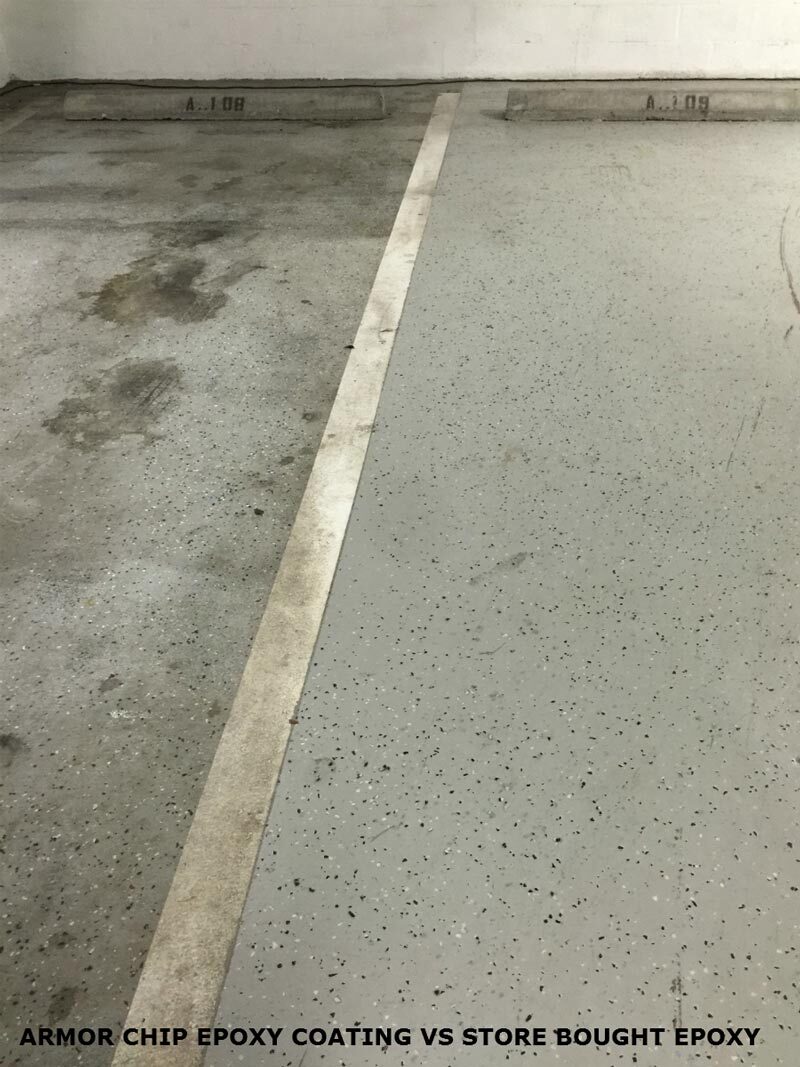
In less than a year, the big-box floor (left) started looking shabby. The big-box floor required a complete diamond grind and full restart. The ArmorGarage floor needed only a light sanding with 100-grit and a fresh topcoat — restoring it to like-new condition. The owner chose to upgrade from the standard topcoat to our military-grade topcoat, figuring it will last him for the next 15–20 years.
For full case studies including the Larsa Pippen rescue (failed installer epoxy replaced with Armor Granite), 16-year video updates, and the complete warehouse documentation, see our ArmorGarage Epoxy Floor Case Studies.
5 Factors That Determine Epoxy Garage Floor Lifespan
Five factors determine whether an epoxy floor lasts 2 years or 20. Understanding each helps you evaluate any epoxy product before you buy — not just ArmorGarage products, but any system you're comparing.
1. Topcoat Quality (Most Important Factor)
The topcoat is the layer that takes 100% of the wear from tires, foot traffic, dropped tools, chemical spills, road salt corrosion and abrasion. The base epoxy is the structural bond to the concrete. The topcoat is what determines how long your floor stays looking new. A military-grade urethane topcoat can extend lifespan from 5–7 years to 15–20+ years for the same base epoxy.
Cheap epoxy kits skip the topcoat to lower their price point. This is why those floors fail in 1–2 years — the base epoxy is exposed to direct wear with no protective layer above it.
2. Total System Build (Mil Thickness)
Epoxy floor thickness is measured in mils (thousandths of an inch). Thicker systems last longer because they have more material to wear through before failure. ArmorGarage systems build to 14–30 mils total cured thickness depending on the kit. Big-box store kits typically cure to 2–4 mils — a fraction of the thickness of a quality system.
3. Solids Content of the Epoxy
True 100% solids epoxy means everything you apply to the floor stays on the floor as cured film. Water-based coatings have no solids and are up to 50% water, it's why they're so cheap; high-solids products evaporate water or solvents during cure, leaving a much thinner final film. ArmorGarage uses true 100% solids epoxy in both weight and volume in all base coats — verified on the technical data sheet. Only 100% military-grade raw materials made in the USA. Any coating can claim 100% solids; how it's made and what it's made with is what counts. All 100% solids epoxies are not made equal, many use low grade imported materials and are not 100% solids in both weight and volume!
4. Surface Preparation Quality
Even the best epoxy will fail in 1–2 years if applied over inadequately prepped concrete. Proper preparation includes diamond grinding or acid etching to open concrete pores, complete neutralization after etching, and full removal of oil contamination, sealers, or previous failed coatings.
5. Use Conditions and Traffic
Light residential use (one or two cars, occasional foot traffic) is the easiest service condition. Heavy commercial use (forklifts, constant foot traffic, chemical exposure) is dramatically more demanding. Same product, different lifespan ranges depending on what the floor is asked to do.
The common buyer experience: a $200 "heavy-duty" big-box kit looks great for the first year, starts showing wear at 18 months, has stains and bare patches by year 2 or sooner, and requires expensive diamond-grind removal. At which point the homeowner calls us to help redo the project right, or spends another $3,000–$4,000 to have a contractor do it, hoping it lasts longer the second time around. The total cost ends up much higher than buying a quality kit from ArmorGarage in the first place.
The Topcoat Factor: Why Most Companies Don't Talk About It
The topcoat is the single biggest variable in epoxy floor lifespan, and it's the variable most manufacturers and installers minimize because including a real topcoat increases their cost. High quality topcoats are more expensive to manufacture than epoxies! ArmorGarage offers two topcoat tiers, both included in the kit price.
Standard Heavy-Duty Topcoat
Included with all standard ArmorGarage kits. Designed for typical residential garage use with vehicles, foot traffic, and normal chemical exposure (oil drips, road salt, brake cleaner). Documented average service life of 10 years in residential applications. 20 mg abrasion loss rating. Most common topcoats are 25–50 mg, which means they wear off quickly. The mg rating is like the Richter scale — each mg exponentially increases or decreases durability. Anything over 20 mg is not suitable for garage duty.
Military-Grade Topcoat (Upgrade Option)
Chemically hardened urethane topcoat originally formulated for military and industrial applications. Resists hot tire pickup, UV yellowing, chemical attack, and abrasion at significantly higher levels than standard topcoats. This is the topcoat that allowed the 17-year warehouse floor to survive forklift traffic and the 16-year garage to look new after a decade and a half. Recommended for high-use garages, off-road vehicles, workshops, commercial floors, and anyone who wants maximum lifespan. Its 4 mg abrasion loss rating is the best in the industry.
Technical Specs: Why ArmorGarage Lasts as Advertised
Marketing claims about durability are easy to make and hard to verify. The specifications below are the measurable properties that determine actual floor lifespan. These are the numbers you should ask for — from any epoxy manufacturer you're considering.
Compare these specifications to any product you're considering. If the manufacturer can't or won't provide them, that's your answer about expected lifespan. Real performance is measurable; marketing claims are not.
How to Make Your Epoxy Floor Last Longer
Even quality epoxy floors benefit from basic maintenance. The good news: epoxy floor maintenance is dramatically easier than maintaining bare concrete or other floor types. The four practices below extend lifespan significantly without requiring meaningful effort.
- Clean spills promptly. Chemical spills (especially battery acid, brake cleaner, paint stripper) should be wiped up in a timely manner. Most other spills can sit for days without effect.
- Sweep or rinse regularly. Grit and dust act as fine abrasive on the topcoat surface. Even brief seasonal rinses with a garden hose extend topcoat life by years.
- Refresh the topcoat when it shows wear. Rather than letting the floor wear into the base coat (requiring full restart), apply a fresh topcoat layer when needed. Another layer of our topcoat brings the floor back to like-new for another decade-plus.
Cost Per Year of Service: The Lifespan Math
Lifespan matters because cost-per-year-of-service is the real measure of value. A floor that costs less upfront but fails sooner costs much more per year than a quality system that lasts decades. This is only taking the cost of the material into consideration when you add in the time and heartache of a failed cheap epoxy floor it's 10 times worse.
The $899 ArmorGarage Armor Granite kit costs $60 per year of service — less than half the annual cost of "cheap" alternatives that fail within 2 years. For complete pricing across all garage sizes and product tiers, see our 2026 Epoxy Flooring Cost Guide.
Get an Epoxy Floor That Actually Lasts
ArmorGarage offers DIY epoxy kits and complete coating systems for garages, basements, commercial floors, and industrial facilities — all with documented multi-decade service life and military-grade topcoat options. Free shipping on orders over $300. Volume discounts available on commercial and industrial projects.
Not sure which kit fits your project? Our team can recommend the right product, quantity, and topcoat tier based on your specific use case. Free expert guidance — no pressure, just answers from people who actually formulate and install these systems. Browse our ArmorGarage Case Studies for documented long-term installations.
Want a Floor That Lasts 15–20+ Years?