

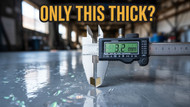
How Thick Is Epoxy Flooring & Why Does It Matter?
Posted by ArmorGarage LLC on Jul 7th 2025
How Thick Should Epoxy Flooring Be? A Manufacturer's Guide
Epoxy flooring thickness ranges from 2 mils for thin decorative coatings to 250 mils (1/4 inch) for self-leveling urethane cement systems. Most home garages need 20 mils total build for proper durability. Commercial floors need 12-20 mils. Industrial spaces with forklifts or heavy equipment need 20-30 mils, sometimes with reinforcing aggregates. The right thickness depends on your specific use case — and getting it wrong is one of the most common reasons epoxy floors fail.
"How thick should epoxy flooring be?" is one of the most common questions we get — and the answer isn't a single number. The right thickness depends on what your floor will actually do: a home garage handling cars and tools needs different thickness than a warehouse floor handling forklift traffic. This guide explains why thickness matters, what thickness ranges work for different applications, and how to evaluate any epoxy product you're considering.
Whether you're applying a decorative epoxy coating for your home garage or a heavy-duty epoxy system for an industrial space, understanding the right thickness ensures you get the durability and long-term protection your space needs.
Visual Reference: Different Epoxy Thicknesses
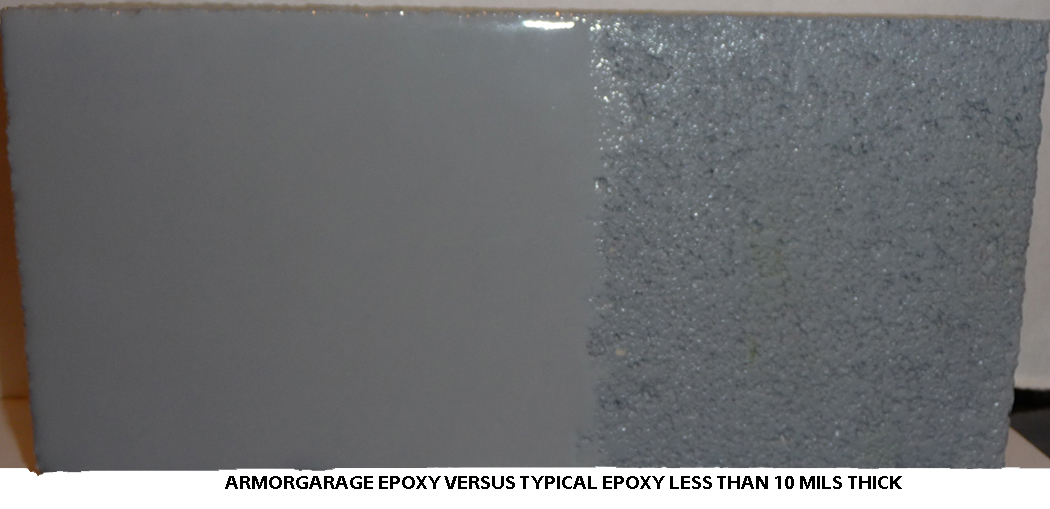
The first image below compares ArmorGarage epoxy (left) to a standard off-the-shelf epoxy coating (right). Notice how thick the leading edge is on the ArmorGarage side and how it filled in the voids of the block. The off-the-shelf product is paper-thin by comparison — you can see the difference immediately.
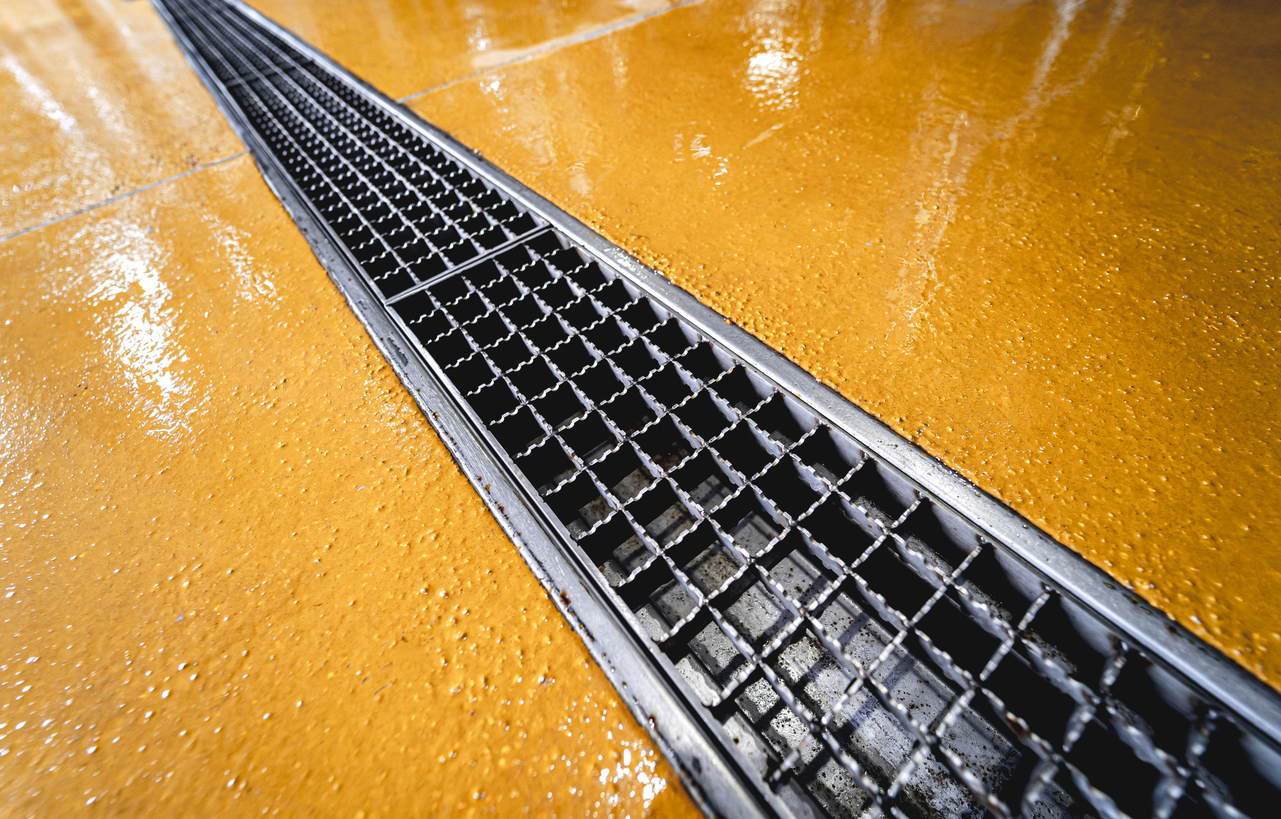
For the heaviest-duty applications, our self-leveling urethane cement slurry can be applied up to 1/4” thick — the kind of thickness that handles tank traffic, not just forklifts.
Why Epoxy Thickness Matters
Thickness directly determines how long your floor lasts and how much abuse it can take. A thin epoxy coating may look good initially, but it wears down quickly under real use. Thicker coatings have more material to wear through, more impact resistance, and more thermal mass — which is critical for handling hot tires.
Hot tire pickup is one of the most common epoxy failures, and it's almost entirely a thickness problem. Thin coatings don't have the critical mass to absorb the heat from your tires. The coating softens, your tires bond to it as they cool, and the next time you back out of the garage, sections of your floor go along for the ride. Quality thicker systems handle the same heat load without softening because there's more material to absorb and dissipate the energy.
Decorative flakes complicate the thickness equation. The flakes physically displace epoxy, so if you start with a thin layer, the area under each flake gets even thinner. With a quality thick base coat, this isn't an issue. With a thin water-based product, you can end up with bare spots under the flakes within months.
One thing to keep in mind: even our thickest epoxy systems are still thin compared to the physical material world. Epoxy thickness is measured in mils (thousandths of an inch), not millimeters. A 30-mil epoxy floor is about 0.76 millimeters — thick for a coating, thin for anything else. This is why getting the thickness right matters so much — you don't have a lot of material to work with.
Epoxy Thickness Ranges by Product Type
Here's how typical epoxy products break down by cured film thickness. One mil = 1/1000th of an inch, so 20 mils = 0.020 inches = roughly half a millimeter.
| Product Type | Typical Thickness | Best For |
|---|---|---|
| Thin water-based epoxy | 2–4 mils | Light decorative coatings, foot traffic only |
| Big-box store garage epoxy | 5–9 mils | Short-term residential use only |
| Quality residential epoxy system | 14–20 mils | Garages, basements, light commercial |
| Heavy-duty commercial system | 20–30 mils | Warehouses, retail, light industrial |
| Heavy tonnage industrial | 30–35 mils | Forklift traffic, heavy equipment |
| Self-leveling urethane cement | 125–250 mils (up to 1/4”) | Food prep, breweries, extreme abuse |
For perspective: oil-based enamel paint is only about 2 mils thick. A standard piece of paper is about 4 mils. A credit card is about 30 mils. So when we talk about a 30-mil epoxy floor, we're talking about something roughly the thickness of a credit card — thick for a coating, but you can see why getting maximum thickness matters.
Recommended Thickness by Application
Here's what we typically recommend based on what your floor will actually do:
- Home garage floors: 14–20 mils total build. Handles cars, SUVs, motorcycles, foot traffic, dropped tools, and light workshop use.
- Heavy-use home garage / workshop: 20–25 mils. Add this thickness if you do significant mechanical work, store heavy equipment, or have multiple vehicles.
- Commercial spaces (retail, showrooms, light shops): 12-20 mils. Handles regular foot traffic, light equipment, and customer use.
- Industrial spaces (warehouses, manufacturing): 25–30 mils, often with aluminum oxide or quartz aggregate for slip resistance and added strength.
- Heavy tonnage industrial (forklifts, heavy equipment): 30–35 mils with the toughest topcoat available.
- Commercial kitchens / food prep: 1/4” (250 mils) self-leveling urethane cement — required by most health departments.
- Metallic epoxy designs: 30–35 mils total to achieve the color depth and glass-like finish that makes metallic floors look right.
How Thick Can Epoxy Be Poured at One Time?
Standard epoxy coatings are applied in layers, not single thick pours. Trying to apply too much at once causes rapid heat buildup as the chemistry cures, which can lead to bubbling, cracking, or improper curing. Each layer in a quality system has a specific job:
- Primer: Penetrates the open pores in the slab created during prep, then locks into those pores forming an unbreakable bond.
- Base coat (epoxy): Provides the structural strength of the system — think of it as the concrete foundation of your floor coating.
- Topcoat: Provides UV stability, abrasion resistance, chemical resistance, stain resistance, and the high-gloss finish.
This is the multi-layer system advantage over single-component products like polyurea, where one product is supposed to do all three jobs. Specialized layers do each job better than one-size-fits-all chemistry can.
For applications where you genuinely need significant single-pour thickness — like food prep areas where the health department requires 1/4” cement — we offer self-leveling urethane mortar systems. Once fully cured, you can drive a tank on these floors without damage.
100% Solids Epoxy: Why It Matters for Thickness
Solids content directly determines how much of the wet application actually becomes the cured film on your floor. This is critical for thickness because most products lose significant volume during cure.
- Water-based epoxy (40–60% solids): Up to 60% of what you apply evaporates as water, leaving a final film thickness less than half of what you rolled on.
- High-solids epoxy (70–97% solids): Better than water-based, but still loses 5–30% during cure. We use these only as primers, never as base coats.
- True 100% solids epoxy: Everything you apply stays on the floor as cured film. What you roll on is what you get.
Watch Out for Fake 100% Solids:
If a spec sheet shows 100% solids in either weight OR volume but not both, it's not truly 100% solids. This is misleading marketing.
Even genuine 100% solids products vary widely in quality. Many use cheap imported hardeners, resins, and pigments. The only thing that's "100%" is that all of it is made with subpar materials. ArmorGarage epoxy is 100% military-grade solids in both weight and volume, 100% USA-made — the difference shows up in long-term performance.
Roll on a high-solids product side-by-side with our 100% military-grade epoxy and the difference is night and day. The high-solids product is like water in comparison — you'll see the difference in coverage, thickness, and how it fills concrete pores.
Surface Preparation Affects Thickness Performance
Even the right thickness fails if applied to inadequately prepped concrete. Concrete must be clean, dry, and properly profiled (mechanically opened up) for the epoxy to bond. If the surface isn't prepped correctly, even a 30-mil coating won't perform — it'll peel, bubble, or delaminate within months because there's nothing for it to grab onto.
ArmorGarage kits include everything you need for proper concrete prep, ensuring the system bonds correctly and lasts as designed. See our complete How To Prep & Epoxy Paint Your Floor The Right Way guide so you only have to do the project once.
Common Questions About Epoxy Thickness
How thick should garage floor epoxy be?
For a typical home garage with cars, foot traffic, and light workshop use, the cured epoxy system should be 14–20 mils total build. This includes primer, base coat, and topcoat layers combined. Floors with heavier use (workshops, multiple vehicles, heavy equipment storage) benefit from 20–25 mils. Floors thinner than 10 mils typically fail within 2–3 years due to insufficient material to handle hot tires and abrasion.
How thick is industrial epoxy flooring?
Industrial epoxy flooring is typically 25–35 mils total build, often with reinforcing aggregates like aluminum oxide or quartz for added strength and slip resistance. For extreme applications like food prep areas, breweries, or facilities with constant heavy equipment traffic, self-leveling urethane cement systems are applied at 1/8” to 1/4” (125–250 mils).
Can you apply epoxy too thick?
Yes — applying too much epoxy in a single coat causes rapid exothermic reaction (heat buildup) during cure, leading to bubbling, smoking, cracking, or improper curing. This is why quality systems are applied in multiple thinner layers rather than one thick pour. Each layer cures properly before the next is applied. The exception is self-leveling urethane cement, which is engineered specifically for thick single-pour application.
What is the minimum thickness for epoxy floor coating?
The minimum thickness for a functional epoxy floor is around 10 mils — below this, the coating won't have enough material to handle normal traffic. Most quality systems aim for 14–30 mils depending on application. Anything thinner than 5 mils is essentially decorative paint and won't survive any meaningful use.
How is epoxy thickness measured?
Epoxy thickness is measured in mils — thousandths of an inch (1 mil = 0.001 inch = 0.0254 mm). Wet film thickness is measured during application using a wet film gauge. Cured (dry) film thickness is measured after cure using a dry film thickness gauge. With 100% solids epoxy, wet and dry thickness are nearly identical because nothing evaporates. With water-based or high-solids products, dry thickness is significantly less than wet thickness due to evaporation.
Does thicker epoxy last longer?
Yes — assuming product quality is consistent, thicker epoxy lasts longer because there's more material to wear through before failure. A 20-mil quality epoxy lasts roughly 2–3x longer than a 6-mil version of the same product. However, thickness alone isn't enough — a thick water-based epoxy still fails faster than a properly built thinner 100% solids system because the underlying chemistry matters too. Look for both adequate thickness AND quality solids content.
Choosing the Right Kit for Your Project
ArmorGarage offers epoxy systems engineered for the right thickness for your specific application. Our kits include the right amount of primer, base coat, and topcoat for your stated coverage area — so applying at the proper thickness happens automatically when you follow the instructions. No guessing about how much to use per square foot.
Whether you need a coating for your garage, a decorative metallic epoxy system, or a super heavy-duty resin flooring system, our kits are designed to deliver long-lasting performance with the right thickness for the job. Complete instructions included — you'll achieve professional results without hiring installers.
For more on related topics, see our How Long Does Epoxy Floor Last guide, our Garage Floor Epoxy FAQs, or browse our garage floor tiles for an alternative coating option.
The Bottom Line on Epoxy Thickness
Epoxy thickness is one of the three factors that determine how long your floor will last (along with solids quality and topcoat performance). For most home garages, aim for 14–20 mils with a quality 100% solids system. For commercial or industrial applications, 25–30 mils minimum. For extreme conditions, self-leveling urethane cement at 1/4” thickness is unmatched.
When evaluating any epoxy product, look at three things: total cured film thickness (in mils), solids content (must be 100% in both weight AND volume), and topcoat composition (urethane, not just clear epoxy). Get those three right and your floor will last decades.