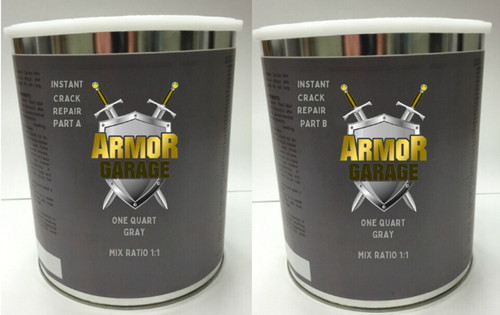


Vertical Concrete Wall Crack Repair Patch
Industrial-grade epoxy compound that fills cracks, voids, and spalled areas on vertical concrete, block, and brick — without sagging. Cures harder than the concrete it's repairing. End repetitive crack repair for good.
Stronger Than the Concrete It Repairs
Most concrete wall crack repair products are grout-based or hydraulic cement — they fill the void but cure at or below the strength of the original concrete. When that concrete continues to move, settle, or absorb moisture, the patch fails again.
ArmorGarage Vertical Concrete Crack Repair Patch is an industrial-grade two-part epoxy compound that cures to 7,800 PSI compressive strength and Shore D 80 hardness — significantly stronger than the 3,000–5,000 PSI of typical concrete. The repair becomes the strongest point in the wall, not the weakest.
Harder than a construction hard hat. Shore D 80 means this cured compound resists impact, abrasion, and compressive loads that would re-crack ordinary patching materials. Once this repair cures, it's not coming back out.
No-sag formula. Specifically engineered to stay put on vertical surfaces — fills voids up to 3/4" wide by 1" deep without slumping or running. Standard epoxies sag on vertical walls; this one doesn't.
What Makes This Different
For deep cracks: Use backer rod to fill the depth first, then apply the epoxy compound as the final repair layer. This reduces material usage on deep cracks without compromising final strength or appearance.
Where It Gets Used
Mixing & Application Instructions
- Prepare the surface — remove all loose concrete, debris, dust, and contaminants from the crack or void. The repair area should be clean and structurally sound. Blow out dust with compressed air if available.
- For deep cracks — insert backer rod to bring the depth to approximately 1" or less before applying the compound. This reduces material usage significantly on deep voids.
- Mix the compound — combine Part A and Part B at a 2:1 ratio by volume (1 part A to 1/2 part B). Mix thoroughly until fully combined. Playground sand can be added to achieve desired pastiness for the specific repair. Mix only what you can use within the 30-minute pot life.
- Apply with a trowel — press the compound firmly into the crack or void, working it in to eliminate air pockets. Smooth the surface to match the surrounding wall profile.
- For separating walls — router a channel across the crack and embed 1/4" metal rods into the wet compound. This creates a structural stitch that ties the two sections together permanently.
- Allow to cure — do not disturb during cure. Once cured, the repair can be painted with any conventional paint or epoxy coating.
Mix flexibility: You can mix as little or as much as needed in a single session — there's no minimum batch size. Just maintain the 2:1 mix ratio and work within the 30-minute pot life. This makes it easy to do small spot repairs without wasting material.
Pot life is 30 minutes at 70°F. Do not mix more than you can apply in that window. In hot weather, pot life shortens — mix smaller batches more frequently. In cold weather, pot life extends.
Frequently Asked Questions
How is this different from hydraulic cement or grout-based crack fillers?
Hydraulic cement and grout-based fillers cure at or below the strength of the original concrete — typically 2,000–4,000 PSI. When the concrete continues to move or absorb moisture, they fail again. ArmorGarage's epoxy compound cures to 7,800 PSI — stronger than the surrounding concrete — and chemically bonds to the substrate rather than just filling the void. It becomes the strongest point in the wall.
Will it sag or run on vertical surfaces?
No. The compound is specifically formulated to be no-sag on vertical and overhead surfaces. It fills voids up to 1/2" wide by 1" deep without slumping. Standard epoxy mortars are too fluid for vertical work — this one is designed for it.
What does Shore D 80 hardness mean?
Shore D is a hardness scale for hard plastics and rigid materials. Shore D 80 is harder than a construction hard hat (typically Shore D 65–75). It means the cured compound resists impact, abrasion, and compression that would damage or re-crack ordinary patching compounds. For reference, most standard epoxy coatings cure around Shore D 75–80 — this compound matches or exceeds that.
Can I use this to repair a wall that is actively separating or moving?
Yes — and the wall stitching technique makes this a permanent structural repair. Router a channel across the crack perpendicular to its direction, embed 1/4" metal rods into the wet compound, and allow to cure. The rods tie the two sections together and prevent further separation. This is the same principle used in structural concrete repair by contractors.
Can I paint over the repair?
Yes — the compound cures to a neutral gray color that blends reasonably well with concrete and block. It accepts any conventional paint, masonry paint, or epoxy coating applied over it. No special primer required for most topcoat applications.
What is the mix ratio and kit size?
The kit contains 1.5 gallons total. Mix at a 2:1 ratio — 1 part A to 1/2 part B by volume. You can mix any quantity as long as you maintain the ratio and use it within the 30-minute pot life. Playground sand can be added to increase body for larger voids.
Does it work on concrete block and brick as well as poured concrete?
Yes — works on all common masonry surfaces: poured concrete walls, concrete block (CMU), brick, and similar masonry. Also suitable for pump pads, manhole surrounds, and any structural concrete application requiring a vertical no-sag repair.
Also see: All Concrete & Asphalt Repair Products
End Repetitive Concrete Crack Repairs for Good
Questions about your specific repair? We'll help you choose the right product and approach.